RAG vs Fine-Tuning vs Prompt Engineering: How Should Developers Choose?
Ever spent weeks fine-tuning an LLM, only to realize a better prompt would have solved the problem easily?
This happens more often than most teams admit and the reason usually isn’t the model. It’s the optimization method chosen for it. Prompt engineering, RAG, and fine-tuning are the three main ways to optimize an LLM. And choosing the wrong one upfront is an easy mistake to make when the pressure is on to ship something fast.
The decision behind the RAG vs fine-tuning vs prompt engineering debate depends on your timeline, your budget, and how much maintenance your team shoulders later. This guide discusses what each approach actually solves, so you can make that call before the time and budget are already spent.
What Sets RAG, Fine-Tuning, and Prompt Engineering Apart
These three methods differ in how they work, what they aim to fix, how much they cost to run, and where they perform best. Here is a breakdown of each one.
How Each One Works
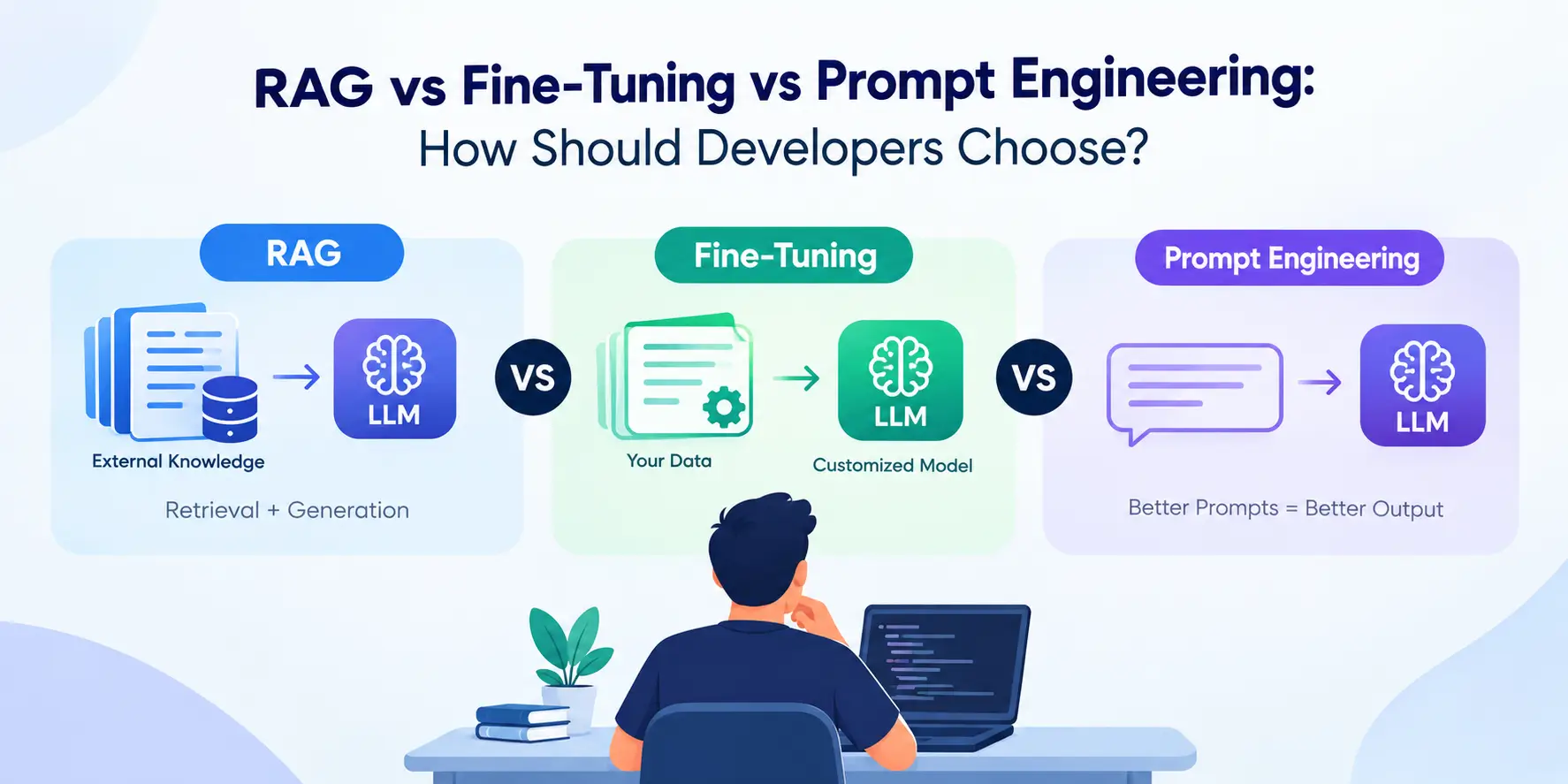
These three methods work differently. The process of steering a model to generate a better output without model retraining is called prompt engineering for LLMs. On the other hand, LLM fine-tuning takes an existing model and fine-tunes it on a specific dataset to improve its performance on a specific task.
Retrieval-augmented generation links a model with an external database to retrieve relevant and timely information when it is queried. It has become one of the fastest-growing LLM optimization techniques in enterprise use today. Even the data supports this too. The global RAG market is projected to grow from $1.96 billion in 2025 to $40.34 billion by 2035, according to a report by ResearchAndMarkets.com, distributed via Business Wire.
What Each One Aims to Achieve
Each method solves a different problem, though all three share the same broad goal of making a model more useful. Prompt engineering gives the desired output on the first try. RAG relies on real and up-to-date data to ensure outputs are more accurate. Fine-tuning helps a model perform consistently well on one specific task. The three are not mutually exclusive, and the best approach for customizing LLMs often combines two or more.
What Each One Costs in Time and Effort
Cost rises with how much infrastructure and data work each method needs. Prompt engineering needs no extra infrastructure, though long prompts and many examples raise the token cost of every call. RAG requires more investment because somebody must keep the data organized and create a data pipeline to keep the data in sync. Fine-tuning needs the most. But parameter-efficient methods such as LoRA have made it easier to do with only a small fraction of compute required to train a model from scratch.
Where Each One Fits Best
Once you know what each method costs and what it’s built to fix, the right fit becomes clearer. Prompt engineering is most effective when it comes to open-ended, creative contexts, such as creating content from scratch. On the other hand, fine-tuning fits tasks that are narrow, repetitive, and subject to precision. RAG is best suited wherever accuracy and freshness are the most important things, like customer support tools, which need correct and up-to-date information every time.
Companies are already moving in that direction. Gartner predicts that by 2028, 80% of GenAI business apps will run on companies’ existing data platforms, with RAG as the key technology behind that shift.
What Does Each Method Take to Maintain?
The maintenance depends on how much each method changes about the LLM. Prompt engineering needs almost none, whereas retrieval-augmented generation needs ongoing data upkeep. Developers must provide the most sustained attention to LLM fine-tuning. This is what it looks like day by day.
Prompt Maintenance
Prompt engineering has the lightest maintenance load of the three. It mostly needs attention when the model’s behavior drifts or the use case changes.
- Rewording prompts when outputs drift
- Testing variations across edge cases against a fixed evaluation set
- Versioning prompts so that a change can be rolled back
RAG Pipeline Maintenance
RAG’s maintenance mostly comes down to one thing that is keeping the data pipeline current. When it falls behind, retrieval quietly breaks, and even the strongest base model starts giving weaker answers.
- Syncing the knowledge base as source documents change
- Monitoring and fixing retrieval quality
- Re-indexing the vector database as data grows
- Re-embedding the whole corpus when you switch or upgrade the embedding model
- Keeping document-level access controls in sync, so users only retrieve what they are allowed to see
Fine-Tuning Maintenance
Most of the maintenance work is required for fine-tuning, and the model itself requires revalidation for each change.
- Curating and cleaning training data
- Retraining on a set cadence
- Revalidating behavior after updates
- Monitoring for performance drift
- Re-running the fine-tune when the provider retires or upgrades the base model
Whichever method you choose, maintenance is not optional. It’s the ongoing cost of keeping the model useful, and planning for it upfront is necessary.
How to Actually Decide Between the Three
To make an informed decision, match the method to what’s actually broken, and check it against your data, speed, budget, and team.
What’s Actually Broken
First, determine the cause of failure. For instance, quoting prices for the last month with support chatbots has a knowledge gap. RAG can fill this gap. That same bot that sends the wrong-toned reply requires improved prompts. Likewise, a legal assistant that continually fails to include the clauses required by a firm is not lacking in data or tone. It has a consistency problem. Try a clause checklist in the prompt and retrieval from the firm’s clause library first. If it still drifts, fine-tuning on the firm’s approved contracts can make the pattern reliable.
How Often Your Data Changes
A fintech chatbot answering interest-rate questions works in a world where the numbers can shift weekly, sometimes daily. This is where RAG, or a direct tool call to a live rates API, keeps answers current. A marketing team that is creating ad copy has relatively static inputs, and a good prompt template would work for this. However, if a legal firm is creating contracts in a standard style, consistency is required and that is what fine-tuning provides.
Latency Tolerance
If your app needs to be flawless and you don’t want to incur an additional retrieval step, such as a live chat app handling thousands of concurrent chats, then fine-tuning will be a great choice. If speed is not as important as flexibility, then prompting will help. And when you are creating a project where it is more important to get the right answer than to get the answer quickly, RAG’s small retrieval delay is worth it.
Budget Consideration
Budget is an important consideration factor here. Prompting costs very little. It’s the logical first step when you’re merely doing some initial testing. As your data and traffic increase, so do your RAG costs. Fine-tuning requires the most initial investment and makes sense for a problem that is tight, very specific and justifies the expense.
Team’s Ability to Maintain It
Ask yourself who’s going to keep this running a year from now. Prompting is more effective for a small team with no dedicated infrastructure. A team with some data engineering support can generally maintain a RAG pipeline. Fine-tuning is best left to organizations with in-house ML or data science skills and a named owner for retraining after launch.
Sometimes the best answer is a combination. Prompting shapes tone and structure, RAG keeps facts current, and fine-tuning gets layered in only when that combination reaches its limit.
Where Teams Get This Choice Wrong
Teams make most mistakes by skipping diagnosis, misjudging what a method can do, or underestimating ongoing maintenance.
- Teams view prompting as a tool that will be a lifelong solution. Even if you try to extract facts from the model that it was not trained on, there will still be knowledge gaps.
- Teams underestimate the maintenance work required for RAG. They establish a retrieval pipeline and presume it will run on its own. But stale data quietly breaks answer quality long before anyone notices.
- Skipping the diagnosis step causes more trouble than it should. Teams pick a method based on what’s trending instead of identifying the actual failure, whether it’s a knowledge gap, a tone issue, or a reasoning problem.
- Overlooking maintenance capacity catches teams off guard later. A team without ML infrastructure takes on fine-tuning’s retraining cycle anyway, then struggles to sustain it once the model is in production.
What This Means for Your Next Project
The discussion of RAG vs Fine-Tuning vs Prompt Engineering is simply about the method for the true failure you are experiencing, the funds you have, and the maintenance your team can actually sustain.
Begin with the least expensive solution for the problem you diagnosed. If the model has the correct information but provides it poorly, then edit the prompt. Add RAG if it is not up to date with the information. Fine-tuning is not needed until you have determined the simpler layers are not sufficient. It’s the order of things that is more important than the tools.
Author Bio

Samrat Biswas is a distinguished VP of Operations, Engineering, and Growth in the tech and consulting industry, renowned for his deep expertise in scaling teams and refining processes. Samrat’s writings are informed by his wealth of experience, offering readers valuable insights into the intricacies of engineering leadership, operational efficiency, and driving transformational change within organizations.
Website: