
MCP Stateless Architecture: What’s New in MCP 2026
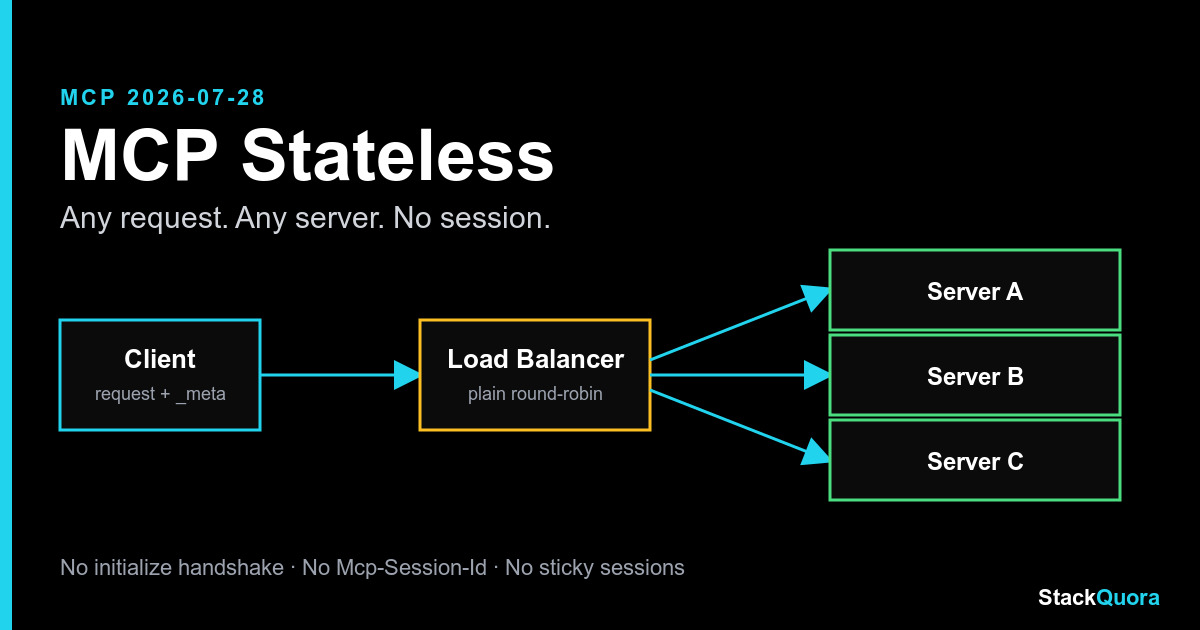
Picture a busy MCP server running on three machines behind a load balancer. A client says hello to machine two. Its next request lands on machine one. Machine one has never heard of this client, so the call fails. For a long time, this was a normal headache for anyone running MCP at scale.
The MCP 2026 specification fixes it. The new revision, dated 2026-07-28, makes MCP stateless at its core. The old handshake is gone. The Mcp-Session-Id header is gone. Every request now carries what the server needs to answer it.
In this guide, you’ll learn what MCP stateless architecture means, how requests look now, what broke, what got better, and how to move your own server across. Examples are kept simple, and every claim here comes from the official spec and release notes.
In short:
- Stateless MCP means each request stands on its own. No session is needed.
- The
initializehandshake andMcp-Session-Idare removed from the protocol. - Any server instance can answer any request, so scaling gets much easier.
- Server questions mid-call now use Multi Round-Trip Requests (MRTR).
- Authorization got tighter, and the old Dynamic Client Registration is deprecated.
- Your app can still keep state. You just do it openly, not inside the transport.
What Is MCP?
Model Context Protocol Explained
MCP stands for Model Context Protocol. It’s an open standard that lets AI apps talk to outside tools and data in one common way. Think of it as a universal plug. An AI client plugs into an MCP server, and the server offers things like tools (actions), resources (data) and prompts (ready-made templates).
Before MCP, every AI app needed custom code for every tool. With MCP, you write a server once, and any compatible client can use it. You can read the basics on the official MCP site. If you want to see MCP doing real work, our guide to Playwright MCP shows an AI agent driving a browser through the protocol.
Why MCP Became Important
MCP grew fast because it solved a real pain. AI agents are only useful when they can act: read a database, file a ticket, run a test. MCP gave them a shared way to do that. The maintainers say the main SDKs now see close to half a billion downloads a month.
It also fits how people build today. When you’re vibe coding an app with an AI assistant, MCP servers are often how that assistant reaches your files, your tools and your services.
But success brings load. Once thousands of users hit remote MCP servers, the original session design started to hurt. That’s the problem this release solves.
How Traditional MCP Sessions Worked
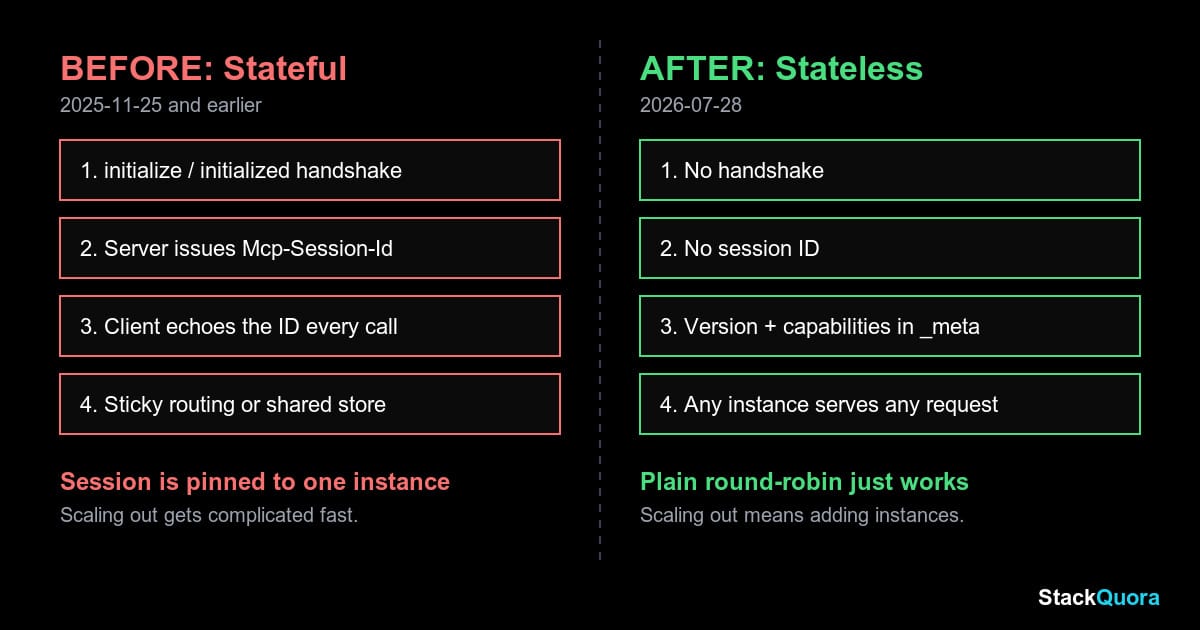
Under the older revisions (2025-06-18 and 2025-11-25), a connection began with a small ritual:
- The client sent an
initializerequest. This shared the protocol version and what the client could do. - The server replied, and over HTTP it could include an
Mcp-Session-Idheader. - The client sent an
initializednotification. - From then on, the client had to send that same session ID on every request.
That worked fine on one machine. The server kept the session in its memory and everything lined up. The trouble started when you added more machines.
If the load balancer sent request two to a different instance, that instance had no record of the session. Teams had two bad choices. They could use sticky sessions, which pin each client to one instance. Or they could build a shared session store, such as Redis, so every instance could look up every session. Both added cost, moving parts and ways to fail.
Sticky sessions also make rolling updates and auto-scaling harder. When an instance dies, every session pinned to it dies with it.
What Changed in MCP 2026?
The July 2026 MCP Specification
On 28 July 2026, the MCP team released the 2026-07-28 specification. In the official release post, the maintainers describe the headline change plainly: MCP moves from a bidirectional stateful protocol to a request/response stateless one. Partners like AWS, Cloudflare, Google Cloud and Microsoft have publicly welcomed it, and the four Tier 1 SDKs (TypeScript, Python, Go and C#) already support it.
Besides the stateless core, this MCP protocol 2026 release adds:
- Header-based routing with
Mcp-MethodandMcp-Name - Multi Round-Trip Requests (MRTR) for mid-call questions
- Cacheable list results with
ttlMsandcacheScope - Tougher authorization rules
- A formal extensions framework, with Tasks as an extension
- A deprecation policy with a minimum twelve-month window
The full text lives in the MCP 2026-07-28 specification.
Removing Protocol-Level Sessions and the MCP Session ID
The first big move is simple to say. The protocol no longer has sessions on Streamable HTTP, and the Mcp-Session-Id header is removed. This is what people mean by “MCP sessionless.”
A side effect matters too. List endpoints like tools/list no longer change from one connection to another. Every client asking the same server gets the same catalog. That makes caching and testing far easier.
Removing the Initialization Handshake
The second move removes the initialize and initialized exchange. There’s no “hello” step anymore. The client just sends the real request. Everything the handshake used to share now rides along inside each request, which the next sections explain.
What Does Stateless MCP Mean?
Stateless Architecture Explained
A stateless protocol doesn’t remember earlier requests. Each request carries all it needs. Compare two ways of ordering coffee. In the first, you tell the barista your usual order once, and they remember it all week. In the second, you say your full order each time. The second is a bit wordier, but any barista in any shop can serve you.
That’s the idea behind stateless MCP. The server doesn’t keep a “conversation” with each client at the protocol level.
One thing is easy to get wrong. A stateless protocol does not force a stateless app. Your shopping cart, your workflow or your user data can still live somewhere. The change is about where. It no longer hides in the transport. If your app needs memory, you build it in the open.
How MCP Requests Work Now
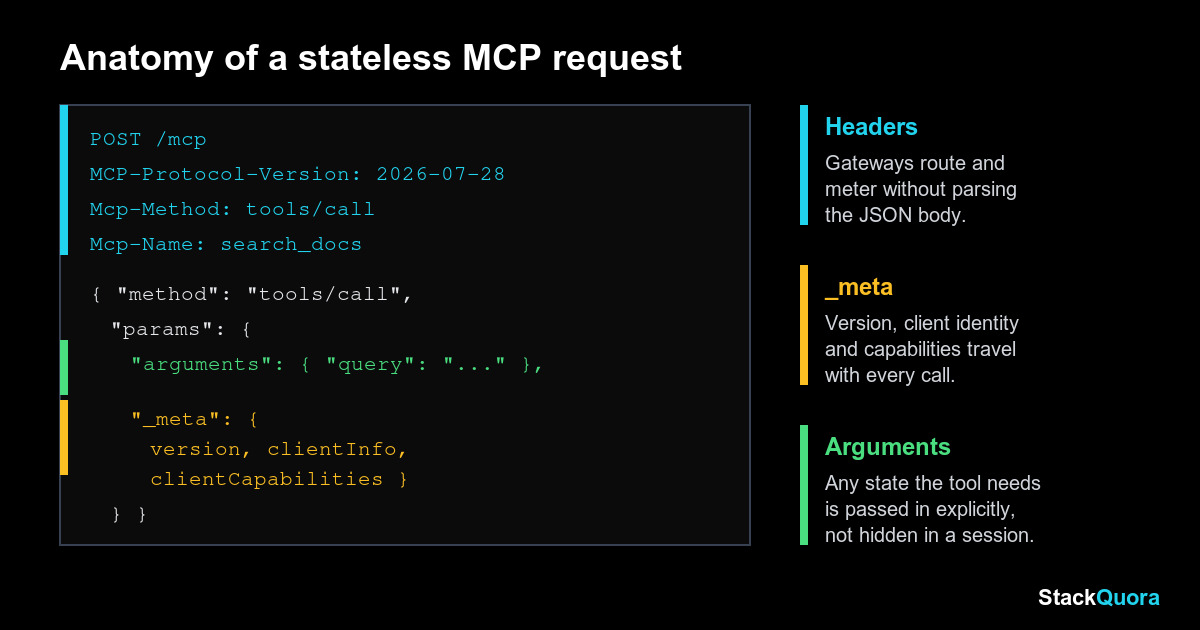
Here’s a simplified stateless request in the MCP 2026 spec, using Streamable HTTP:
POST /mcp HTTP/1.1
Content-Type: application/json
MCP-Protocol-Version: 2026-07-28
Mcp-Method: tools/call
Mcp-Name: search_docs

{
  "jsonrpc": "2.0",
  "id": 1,
  "method": "tools/call",
  "params": {
    "name": "search_docs",
    "arguments": { "query": "refund policy" },
    "_meta": {
      "io.modelcontextprotocol/protocolVersion": "2026-07-28",
      "io.modelcontextprotocol/clientCapabilities": {},
      "io.modelcontextprotocol/clientInfo": {
        "name": "support-bot",
        "version": "1.2.0"
      }
    }
  }
}
Notice what’s missing. There’s no session ID. No earlier call is needed. This one request is enough. For a client, the first tool call drops from two or more trips to one.
Request-Level Metadata
Three things now travel with each request:
- Protocol version. The client says which version it speaks, every time. If the server can’t handle that version, it returns an
UnsupportedProtocolVersionerror. - Client capabilities. What the client supports, such as extensions, goes in
_meta. - Client identity. Clients should say who they are on each request. Servers should do the same in their results.
What if a client wants to know a server’s abilities before doing anything? The spec adds a server/discover call. Every server must implement it, but clients only call it if they want to. It returns supported versions, capabilities and identity. This is the same spirit as how AI agents find tools: ask first, then decide what to use.
Explicit State Management
If your server needs to remember something between calls, the spec has a clear pattern. Have a tool create a handle, such as a cart ID or workflow ID. Return it to the model. The model passes that handle back as a normal argument on later calls.
The maintainers say this works better than state hidden in the transport. The reason is simple: the model can see the handle and carry it from tool to tool. Hidden session state was invisible to the model.
The data behind the handle can live in a database, a cache or a vector database. That choice is yours.
MCP Stateful vs Stateless Architecture
Stateful MCP Architecture
In the old design, the transport held the memory. The server created a session, stored it, and expected the client to return with the same ID. Requests from one client had to reach the same place, or the system needed a shared store to bridge the gap. Server-to-client messages also leaned on long-lived open streams.
Stateless MCP Architecture
In the new design, the request holds the memory. It names its own version and capabilities. Because of that, no instance is special. Whichever server catches the request can answer it. Open streams are no longer needed for the main flow.
Key Differences
- Startup: Stateful needs a handshake first. Stateless sends the real request right away.
- Session ID: Stateful uses
Mcp-Session-Id. Stateless has none. - Routing: Stateful often needs sticky sessions. Stateless works with plain round-robin.
- Shared storage: Stateful may need a session store. Stateless needs none for the protocol.
- Server questions: Stateful used server-initiated requests over open streams. Stateless uses MRTR.
- Failure: Stateful loses the session if an instance dies. Stateless just retries on another instance.
Advantages of Stateless MCP
Load Balancing
MCP load balancing gets simple. Any ordinary load balancer can spread requests evenly. You don’t need session-aware rules or special affinity settings. Because Mcp-Method and Mcp-Name are now headers, gateways can even route and rate-limit without opening the JSON body.
Horizontal Scaling
Need more capacity? Add more instances. Nothing has to be copied or synced between them. This is the heart of MCP scalability. It also pairs nicely with containers. If you’re new to packaging servers that way, start with our Docker tutorial.
Shared Session Stores
Many teams ran a shared store only to keep MCP sessions alive. At the protocol level, that need goes away. A word of caution, though: you may still need a store for your own app data, such as carts, jobs or user progress. Don’t delete your database just because the protocol is stateless. Check what each piece of stored data is really for first.
Cloud Infrastructure
Cloud platforms like stateless workloads. They can start, stop and replace instances freely. AWS and others have already pointed out that removing sticky sessions and session storage simplifies remote MCP deployments, as InfoQ reported.
Serverless Deployments
Serverless functions start cold and may live for only one request. That was a poor match for sessions. A stateless MCP server fits naturally. Cloudflare said its Agents SDK supports the spec so servers can run directly in Workers. Each invocation handles one self-contained request and exits.
MCP Stateless HTTP Architecture
MCP Streamable HTTP
Streamable HTTP is the transport MCP uses for remote servers. In the 2026 revision, it becomes much closer to ordinary web traffic: a client POSTs a request, and the server answers. Details are on the Streamable HTTP page.
Some older features were removed or replaced. SSE stream resumption through Last-Event-ID is gone. If a response stream breaks, the in-flight request is lost, and the client must send it again as a new request with a new request ID. That means tools with side effects should be built so a safe retry is possible. The old HTTP GET notification endpoint is replaced by a single subscriptions/listen stream that clients opt into.
Header-Based Routing
Streamable HTTP POST requests must now include Mcp-Method (like tools/call) and Mcp-Name (like the tool name). Your gateway, rate limiter or firewall can use these headers directly. The server also checks them against the JSON body. If they don’t match, the request is rejected with a header mismatch error. That stops a sneaky client from labeling a dangerous call as a harmless one.
Tools can also expose chosen parameters as custom headers through x-mcp-header, which helps with routing decisions.
Multi-Round-Trip Requests
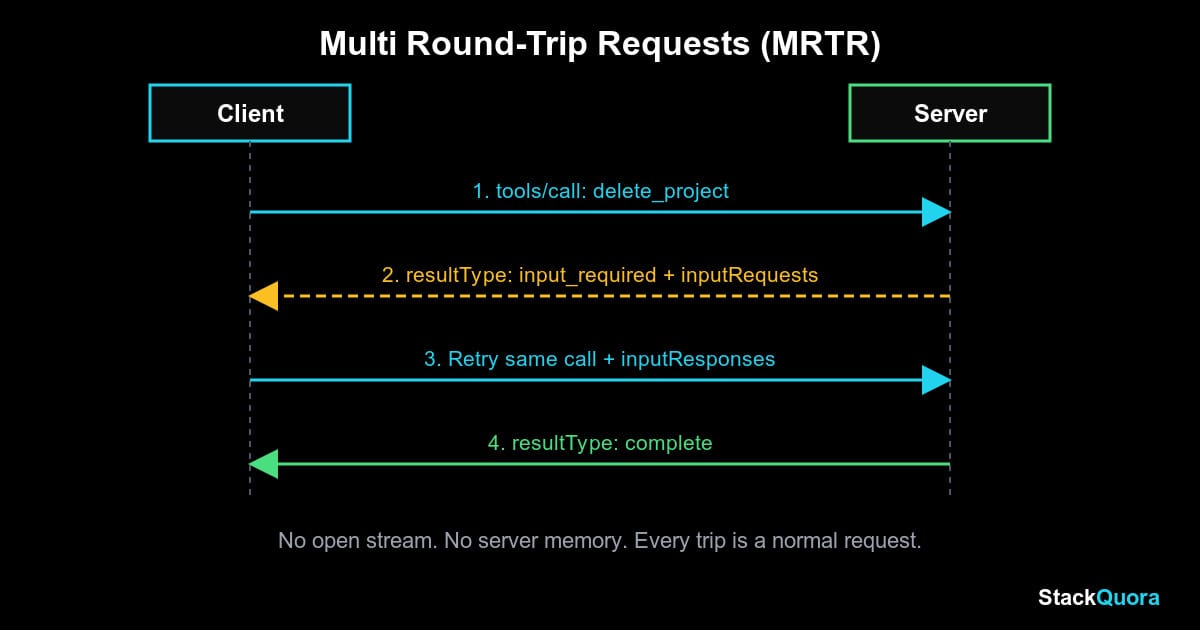
Here’s a puzzle. Sometimes a tool needs to ask the user something halfway through. “Delete this project? Yes or no?” Before, the server pushed a question down an open stream. A stateless server can’t hold a stream open and remember who it was talking to.
The answer is Multi Round-Trip Requests (MRTR). It works like this:
- The client calls a tool.
- The server replies with
resultType: "input_required"plus the questions it needs answered. - The client gets the answers (often by asking the user).
- The client retries the original call with
inputResponsesattached. - The server finishes and returns
resultType: "complete".
No server memory is needed between steps. If the server needs to link the retries together, it can put its own identifier in requestState. Supabase said this is what finally lets its stateless MCP server confirm costly or destructive actions before running them. The MRTR pattern page has the exact shapes.
MRTR replaces the old server-initiated elicitation/create, sampling/createMessage and roots/list requests.
Caching List Results
Results from tools/list, prompts/list, resources/list and resources/read now carry ttlMs (how long the answer stays fresh) and cacheScope (public or private). Clients can cache catalogs instead of re-fetching them. Servers should also return tools in a steady order, which helps AI prompt caches stay stable.
MCP 2026 Breaking Changes
This is a big release, and some changes will break old code. The official changelog lists everything. Here are the parts that matter most.
Session Changes
Mcp-Session-Idis removed from Streamable HTTP.- Protocol-level sessions are gone.
- List endpoints no longer vary per connection.
- Cross-call state should use server-created handles passed as normal tool arguments.
Protocol Changes
- The
initializeandinitializedhandshake is removed. - Version, capabilities and client info move into
_metaon every request. server/discoveris added, and servers must implement it.- All results carry a required
resultTypefield. ping,logging/setLeveland a few notifications are removed. The log level is now set per request.- SSE resumability (
Last-Event-ID) is removed. - Resource-not-found errors now use
-32602, matching JSON-RPC.
Authorization Changes
- Clients must check the
issparameter (RFC 9207) before redeeming an authorization code. - Saved client credentials are tied to the authorization server that issued them.
- Dynamic Client Registration (DCR) is deprecated in favor of Client ID Metadata Documents (CIMD).
Extension and Deprecation Changes
- Tasks moved out of the core into the
io.modelcontextprotocol/tasksextension, usingtasks/getpolling and a newtasks/update. - Roots, Sampling and Logging are deprecated. They still work and will for at least twelve months.
- The old HTTP+SSE transport is officially deprecated. Use Streamable HTTP.
- A formal deprecation policy sets a twelve-month minimum window before removal.
Migration Considerations
A calm, step-by-step plan works best:
- Search your code for
initialize,initializedandMcp-Session-Id. Every hit is a place to review. - List what each session value was used for. Protocol version and client info now come from each request. Anything else needs a new owner. If a value has no clear owner, don’t delete it yet.
- Add
server/discover. It’s required for 2026-07-28 servers. - Return
resultTypeon every result, and addttlMsandcacheScopeto list responses. - Replace server-initiated questions with MRTR.
- Work in a safe place. Do this on a separate Git branch so you can compare and roll back.
- Automate the checks. Run both old-style and new-style requests in CI. Our GitHub Actions guide shows how.
Upgrade the SDK first. The official SDKs include migration notes, and they handle much of the header and _meta work for you.
MCP Stateless Architecture Example
Traditional MCP Request Flow
Here’s the old way, in plain steps:
1. Client  -> POST initialize
2. Server  -> 200 OK + Mcp-Session-Id: abc123
3. Client  -> POST notifications/initialized (with abc123)
4. Client  -> POST tools/call (with abc123)
5. Server  -> 200 OK, result
Five steps for one tool call. And step 4 had to reach the same instance that created abc123.
Stateless MCP Request Flow
Here’s the new way:
1. Client  -> POST tools/call (version + client info in _meta)
2. Server  -> 200 OK, result (resultType: "complete")
Two steps. Any instance can handle step 1. If you want to check a new server by hand, testing it with Postman is easy now, because one POST is a full test. No setup call comes first.
Managing Application-Level State
Say your tools build a shopping cart. The protocol is stateless, but the cart is real data. Here’s the handle pattern. This is a simplified illustration, not real SDK code:
// Tool 1: create a cart and hand back an explicit handle
async function createCart(userId: string) {
  const cartId = crypto.randomUUID();
  await db.carts.insert({ cartId, userId, items: [] });
  return { cartId }; // the model sees this and passes it back later
}

// Tool 2: ANY server instance can run this call
async function addItem(userId: string, cartId: string, sku: string) {
  const cart = await db.carts.find({ cartId, userId }); // check ownership!
  if (!cart) throw new Error("Cart not found");
  await db.carts.addItem(cartId, sku);
  return { cartId, itemCount: cart.items.length + 1 };
}
Two things to notice. The state lives in a database, not in server memory. And the lookup checks both cartId and userId, so a guessed handle can’t open someone else’s cart. If the TypeScript syntax is new to you, our TypeScript tutorial covers it. For the storage side, our SQL tutorial shows how to model data like this.
MCP Stateless Security
Removing sessions changes where security checks happen. They move into every request.
Authentication
MCP authorization 2026 pushes clients toward Client ID Metadata Documents (CIMD). With CIMD, a client identifies itself with a URL that points to a metadata document, instead of registering dynamically with each server. DCR still works for backward compatibility but is deprecated and will be removed in a future version. Read the client registration page before you plan your auth setup.
Authorization
Two new rules close real holes. First, clients must validate the iss parameter described in RFC 9207 before redeeming an authorization code. This blocks “mix-up” attacks, where a client is tricked into sending a code to the wrong authorization server. Second, client credentials are bound to the server that issued them. A client can’t reuse them elsewhere, and it must re-register if the authorization server changes.
Request Validation
Since every request stands alone, validate every request. Check the protocol version. Check that Mcp-Method and Mcp-Name match the body. Check the token. Validate the arguments. A stateless server can’t rely on “we already checked this client earlier,” because there is no earlier.
State and Identity Management
Handles are not logins. A cart ID is just a pointer. Always tie data to the authenticated user and check ownership on each call, as in the example above. Never trust _meta client info as proof of identity, since a client can claim anything. Use your auth token for that.
Should Developers Upgrade to MCP 2026?
When to Upgrade
Upgrade soon if any of these are true:
- You run MCP servers on several instances or in the cloud.
- You use sticky sessions or a session store only for MCP.
- You deploy to serverless or edge platforms.
- Your users’ clients are moving to 2026-07-28.
If you run one local server for yourself, there’s less rush. Still, plan the move. Roots, Sampling and Logging are on the deprecation path, and the old SSE transport is on its way out.
Compatibility Considerations
This is a breaking change at the protocol level. A 2026 client talking to a server that only expects a handshake can get an error or be misrouted. A server that speaks only the new version also can’t serve older clients. Plan for a period when both exist.
Migration Challenges
Expect trouble in these spots:
- Code that depended on session IDs. The maintainers admit this has the biggest cost.
- Hidden state. Something may have quietly lived in session memory.
- Retry safety. Lost streams now mean re-sending a request, so make side effects safe to repeat.
- Testing. Cover both old and new paths. Our guide to AI-powered test automation can help you scale those checks.
Supporting Older MCP Clients
Older clients keep working only if you run the old session path next to the new one. Some gateways and platforms already serve both at one endpoint. A common plan is to detect the version from the request, route it to the right handler, and set a date to retire the legacy path. The twelve-month deprecation policy gives you a realistic window.
The Tier 1 SDKs are available now: TypeScript, Python, Go and C#. If you’re brushing up first, see our JavaScript tutorial and our Python tutorial.
Final Thoughts
MCP stateless architecture is a simple idea with big effects. By dropping the handshake and the session ID, the protocol now behaves like the rest of the web. Requests are self-describing, any instance can answer them, and a plain load balancer is enough. For anyone running MCP at scale, that’s a real relief.
You don’t need to migrate in one afternoon. Start by finding every place your code touches sessions. Upgrade your SDK. Move any hidden state into explicit handles. Then test old and new paths side by side.
The big shift to remember: the protocol forgets, so your app must remember on purpose. Do that well, and MCP 2026 gives you a faster, calmer and cheaper way to run your servers.
Frequently Asked Questions About Stateless MCP
What is stateless MCP?
Stateless MCP means each request is self-contained. The server doesn’t need protocol-level memory of earlier requests. The handshake and session ID are gone, and each request carries its own version, client info and capabilities.
What changed in MCP 2026?
The 2026-07-28 spec made MCP stateless at its core. It also added server/discover, header-based routing with Mcp-Method and Mcp-Name, Multi Round-Trip Requests, cacheable list results, stronger authorization rules, an extensions framework and a formal deprecation policy.
Is MCP now completely stateless?
The protocol is, but your app doesn’t have to be. If a tool needs memory, it creates an explicit handle (like a cart ID) and the model passes it back as an argument. State just moves out of the transport and into your own storage.
What happened to Mcp-Session-Id?
It was removed from Streamable HTTP in the 2026-07-28 spec. Servers no longer issue it, and clients no longer send it. A 2026-only server ignores it if an old client still sends one.
Is MCP 2026 backward compatible?
Not automatically. The change is breaking at the protocol level. Older clients keep working only if your server also runs the old session path. Many teams will support both for a while.
Does stateless MCP improve performance?
Mostly it improves scalability and reliability. The first call needs fewer trips because the handshake is gone, and load balancing is simpler. It doesn’t make your tool code itself run faster, and small extra data per request is a trade-off.
What is server/discover?
It’s a new call that returns a server’s supported versions, capabilities and identity. Every 2026 server must implement it. Clients may use it to learn what a server can do before sending other requests, but they aren’t required to.
What are Multi Round-Trip Requests?
MRTR lets a server ask for more input mid-call without holding a stream open. The server returns input_required with its questions. The client retries the call with inputResponses. It replaces the old server-initiated elicitation, sampling and roots requests.
Do I still need Redis or a shared session store?
Not for MCP sessions, since they no longer exist. You may still need storage for your own app data, such as carts or jobs. Check what each stored value is used for before removing anything.
What replaces Dynamic Client Registration in MCP 2026?
Client ID Metadata Documents (CIMD). DCR is deprecated but still works for backward compatibility, and it will be removed in a future spec version.